

Summary
- Net income among community banks increased 8.2% from the prior quarter.
- Industry net interest margin increased 1 basis point from the prior quarter to 3.32%.
- Domestic deposits grew 0.8%, the eighth consecutive quarterly increase.
- Loan growth was widespread, increasing 1.8% from the prior quarter and 6.8% from the prior year.
- Asset quality metrics improved, as both the past-due and nonaccrual and net charge-off rates declined from the prior quarter.
- The Deposit Insurance Fund reserve ratio increased 5 basis points to 1.48%.
The banking industry finished the quarter with higher earnings, resulting in a return on assets ratio (“ROA”) of 1.37%. Domestic deposits increased for the eighth consecutive quarter and loan growth was strong. Asset quality metrics improved, while unrealized losses remained elevated. The banking industry continued to have strong capital and liquidity levels, which support lending and protect against potential losses.
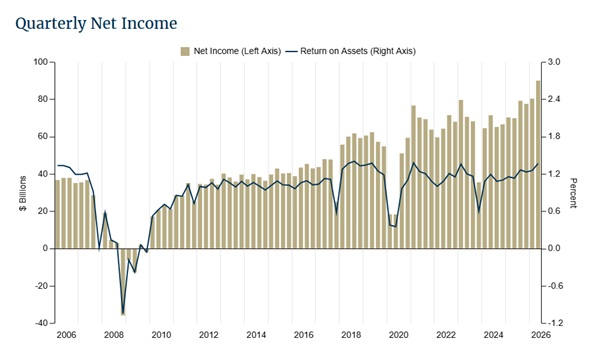
Chart 1 above shows that the banking industry reported quarterly net income of $90.1 billion in the second quarter, an increase of $9.7 billion, or 12.0%, from the prior quarter. The rise in quarterly earnings was driven by robust growth in non-interest income and securities gains. Net interest income and lower provisions also contributed to the rise in quarterly earnings, which were partially offset by higher non-interest expense. The banking industry reported an ROA of 1.37% in the second quarter of 2026, up 11 basis points from the prior quarter and up 24 basis points from the year-ago quarter.

Chart 2 above shows the breakdown of the changes in the industry’s net income quarter over quarter. The primary drivers of the industry’s $9.7 billion increase in net income were higher non-interest income (up $5.5 billion, or 6.1%), mostly due to trading revenues given continued market volatility and higher fee income, and securities gains, primarily from one-time gains on equity security transactions (up $5.5 billion). Net interest income (up $5.3 billion, or 2.8%) also contributed to the increase in net income. Industry gains were partially offset by higher non-interest expense, which increased $4.4 billion, or 2.8%.
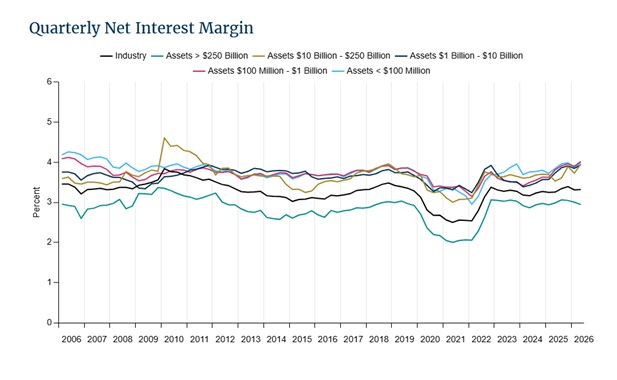
Chart 3 above shows the average net interest margin (“NIM”) for the industry and the five asset-size groups on which the Quarterly Banking Profile reports. The industry’s NIM increased to 3.32%, up 1 basis point from the prior quarter and up 6 basis points from the year-ago quarter. The community bank NIM increased to 3.81%, up 10 basis points from the prior quarter and up 19 basis points from the year-ago quarter
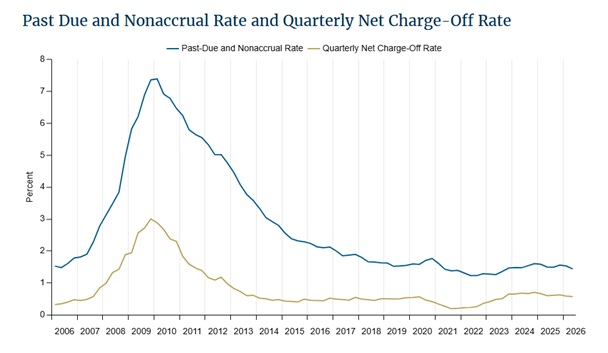
The chart above shows that asset quality metrics for the industry are improving. The overall past-due and nonaccrual (“PDNA”) rate decreased 9 basis points from the prior quarter to 1.44%. Quarter over quarter, banks reported declines in PDNA rates across most major loan categories. The industry’s quarterly net charge-off rate was 0.57%, down 2 basis points from the prior quarter and 3 basis points from the year-ago quarter.

The chart above shows the change in loan balances on a quarterly and annual basis. The industry’s total loans increased 1.8% in the second quarter, with widespread growth across portfolios. Loans to non-depository financial institutions (“NDFIs”) and commercial and industrial (C&I) loans had the largest dollar increase among reported categories. Loans to purchase or carry securities, including margin loans, also contributed to the industry’s quarterly loan growth. The industry’s annual rate of loan growth in the second quarter was 6.8%. Total loans at community banks increased 1.6% from the prior quarter and 5.1% from the prior year, led by increases in nonfarm nonresidential commercial real estate (CRE), 1-4 family residential real estate, and C&I portfolios.
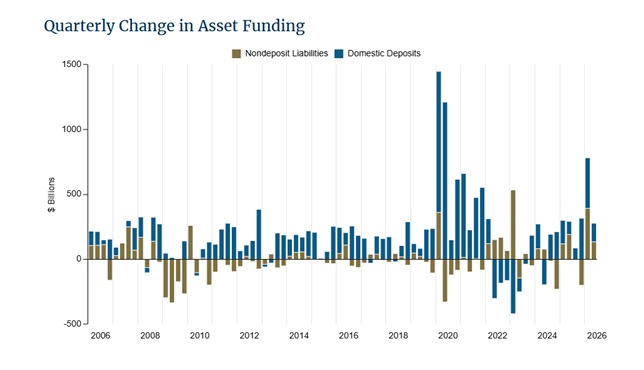
The chart above demonstrates that domestic deposits increased for the eighth consecutive quarter, rising 0.8% during the second quarter. Estimated uninsured domestic deposits accounted for all of the increase in domestic deposits from the prior quarter, as insured deposits decreased slightly. The industry’s non-deposit liabilities also increased during the quarter, driven by an increase in Federal Home Loan Bank advances and other borrowed money.
The chart below shows the number and percentage of banks on the FDIC’s “Problem Bank List.” Banks on this list have a CAMELS composite rating of “4” or “5.” The number of banks on the list declined by a net of seven in the second quarter to 47 banks. The number of problem banks was 1.1% of total banks, which is in the normal range of 1 to 2% for non-crisis periods. Four banks opened and one bank failed during the second quarter.
